
Frequently asked questions
Frequently asked questions
about microcement and Lavasteen
Answers to the questions customers ask us most often — about the materials, application, colours, maintenance and price. Can't find your question? Get in touch, we're happy to help.
Materials
What are microcement and Lavasteen?
What is microcement?
Microcement is a thin mineral wall and floor finish (1–2 mm) with a matte concrete look. Seamless, matte, in any desired colour. On walls it becomes waterproof through two to three layers of PU topcoat. Suitable for bathroom walls, feature walls in living rooms and light kitchen floors.
What is Lavasteen Seamless Floor?
Lavasteen Seamless Floor is a trowel-applied finish in which ground lava stone in epoxy is applied. The epoxy components form a closed mass that is fully waterproof — even if the top surface is damaged. The natural granular structure provides a slip-resistant texture. Suitable for floor and wall, especially in bathrooms, kitchens and heavy-traffic floors.
What is the difference between Lavasteen and microcement?
Lavasteen is a trowel-applied epoxy compound 1–2 mm thick, fully waterproof in itself and suitable for heavy-duty floors. Microcement is a thin mineral layer of 1–2 mm whose waterproofing depends on a PU topcoat — ideal for walls. We often combine them: microcement on the wall, Lavasteen on the floor.
Spaces
Which material in which space?
Which material should I choose for my bathroom?
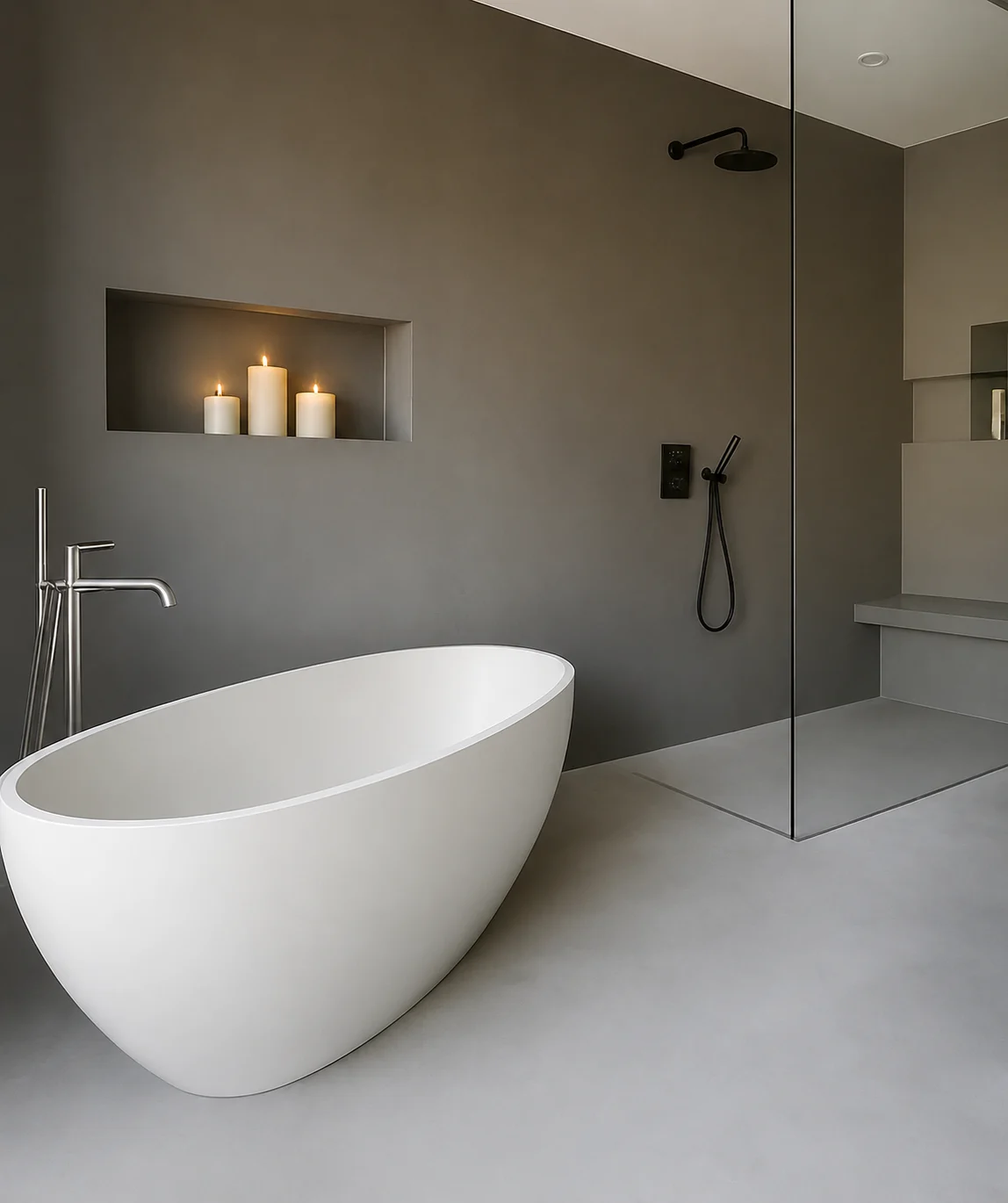
In the bathroom we recommend microcement on the wall and Lavasteen Seamless Floor on the floor. Nothing ever falls onto a wall, so the PU topcoat of microcement remains intact. On the floor, Lavasteen offers extra security through its intrinsic water-tightness — even when objects are dropped. Read more about bathroom applications.
Which material should I choose for my kitchen?
On the kitchen splashback, microcement works excellently — no joints where grease and grime can accumulate. For the floor it depends on usage: in a residential kitchen-diner, microcement with PU topcoat suffices; in a commercial or heavily used kitchen we recommend Lavasteen Seamless Floor. Read more about kitchen applications.
Should I choose between microcement and Lavasteen?
Not necessarily. Our standard recommendation: microcement on the wall, Lavasteen on the floor. But Lavasteen can also go on the wall — one material for the entire bathroom. What suits depends on your desired look, budget and lighting situation.
Why not microcement on the floor?
Microcement is mineral-based and becomes waterproof through a PU topcoat. On a wall, nothing ever falls, so the PU remains intact for years. On a floor, a dropped object can damage the PU, allowing moisture to penetrate the mineral layer. For floors, we therefore always recommend Lavasteen Seamless Floor.
Can the entire bathroom be finished in Lavasteen?
Yes. Lavasteen is available for both floors and walls. On the wall, one filling layer of PU is applied; on the floor, the same. For a bathroom, it is by far the best product — fully waterproof thanks to the epoxy components.
Application
Application and substrate
Can microcement be applied over existing tiles?
Yes. We treat the tiles first: degrease, prime, fill joints and level. No demolition required — that saves considerable time and cost during renovation.
Can Lavasteen Seamless Floor be applied over an existing floor?
Yes, in many cases. We first check the substrate for levelness and stability. Existing tiles must be provided with a levelling layer — ensure a crack-free subfloor. In living rooms and non-wet rooms, choose a gypsum-based levelling compound.
How long does installation take?
On average 2 to 3 days for a complete room, depending on surface area and chosen combination. NCS and RAL bespoke colours require additional preparation time for mixing and testing the colour.
Do you provide both application and supply?
Both. Patrick and his team install for clients who want to outsource the work. For DIY enthusiasts, we supply all materials and tools, plus instructions. We ship worldwide; installation by our own team is available in the Netherlands and Belgium.
Colours
Colours and bespoke
How many colours does microcement come in?
36 standard colours, plus bespoke in NCS, RAL and RAL Design. For exact colour matching with an existing wall or brand guideline, that is the recommended route.
How many colours does the Lavasteen Seamless Floor come in?
20 standard colours with natural names such as Sea Shell, Hill Flower, Morning Dew, Hazel, Wool. NCS and RAL are available on request — we then need extra time for mixing and testing, as Lavasteen does not come from a tube.
Will I get exactly the colour I want?
Yes. Choose from 36 standard colours or bespoke shades in NCS, RAL or RAL Design. Always test with colour samples in your own space first — daylight and LED spotlights strongly influence colour perception.
Maintenance
Maintenance and durability
Is microcement waterproof?
On the wall, yes, thanks to two to three layers of PU topcoat. On floors in wet rooms (bathroom, toilet) we recommend Lavasteen Seamless Floor — intrinsically waterproof due to the epoxy base. On floors in dry spaces, microcement with PU is perfectly fine.
Is Lavasteen waterproof?
Yes, intrinsically. The epoxy components form a single dense mass with the lava stone granules that resists water. Even if the top layer is damaged, the material remains waterproof — no mineral underneath that can absorb moisture. That is why it is the material for bathroom floors.
How do I maintain the finish?
Microcement: damp cloth with pH-neutral cleaner, no aggressive degreasers. Lavasteen Seamless Floor: daily sweeping or mopping, and it can even withstand bleach and a brush — rinse thoroughly with water afterwards.
How durable is a Lavasteen floor?
Thanks to the epoxy base with lava-stone aggregate, Lavasteen is considerably more robust than microcement. Under normal use, a Lavasteen floor lasts 15+ years. Local repairs are possible; the granular structure makes repair transitions virtually invisible.
Does Lavasteen work with underfloor heating?
Yes, excellently. The epoxy matrix and lava granules conduct heat efficiently — slightly faster than microcement. For living rooms and bathrooms with underfloor heating, that's a direct advantage.
Is Lavasteen slip-resistant?
Yes, inherently. The natural granular structure provides grip — ideal for bathroom and shower floors where wet feet tread. The single PU topcoat subtly seals the structure without losing the anti-slip property.
What if the microcement wall does get damaged?
Minor repairs can be carried out locally — we touch it up and the transition is usually almost invisible thanks to the matte finish. For larger damage we visit for assessment.
Price
Price and quotation
What does a floor or wall finish cost?
The price depends on surface area, material (Lavasteen or microcement), chosen colour (standard versus NCS/RAL bespoke) and the condition of the substrate. Request a tailored quotation or schedule a site survey — we're happy to visit for advice. Make an appointment.
How much does microcement cost per m²?
Material costs depend on the colour and volume. For a complete price indication including application, we require a site survey — shape, substrate and layers determine the final amount.