What is a seamless floor?
seamless, modern, bespoke.
A seamless floor is a liquid-applied floor finish that cures into one continuous surface. No joints, no transitions — just a seamless, modern appearance. Seamless floors are popular in living rooms, bathrooms and commercial spaces for their clean look, hygiene and durability. Here we explain everything: what a seamless floor is, which types of seamless floors exist, costs, advantages and disadvantages, and how to choose the right one for your project.
What is a seamless floor technically?
A seamless floor (also called poured floor or liquid floor) is a floor finish that is applied in liquid state and then cures into a solid, seamless surface. The floor is usually applied in thin layers (1–3 mm) onto an existing substrate — cement screed, anhydrite, tiles or concrete.
At Smartdeco we work with two product lines, both belonging to the category of 'seamless floor': microcement (mineral) and Lavasteen Seamless Floor (epoxy-based with quartz). Both deliver the same seamless aesthetic, but with different technical properties.
Why seamless floors are so popular
- Seamless — no joints, no transitions. One continuous surface from wall to wall.
- Modern — matte-minimalist appearance that suits contemporary living.
- Hygienic — no dirt edges in joints. Mopping suffices as maintenance.
- Durable — 15+ years lifespan under normal use.
- Underfloor heating — thin application (1–3 mm) provides rapid heat conduction.
- Renovation-friendly — can be applied over existing tiles after preparation.
Which types of seamless floors exist?
There are various types of seamless floors, each with its own technical properties and application area. The four main categories:
1. Microcement (mineral)
Cement-based trowelable floor with polymer and pigments. Matte-minimalist, applied thin (2–3 mm), finished with PU topcoat for waterproofing. At Smartdeco, microcement is our primary choice for walls, furniture and stairs. View our microcement product line.
2. Lavasteen Seamless Floor (epoxy with quartz)
Epoxy-based with fine lava-stone quartz. Inherently waterproof, even when damaged. Robust, wear-resistant, ideal for floors in wet rooms and living spaces. View our Lavasteen Seamless Floor product line.
3. Polyurethane resin floor (PU)
100% synthetic resin floor, often used in industrial environments (car showrooms, production halls, sports floors). Hard, scratch-resistant, chemically resistant — but visually "plastic" and less warm. Not our primary product line as it is rarely suitable for residential use.
4. Polished concrete
Strictly speaking not a poured floor, but often confused — a thick (≥80 mm) concrete subfloor that has been mechanically ground to a smooth surface. Requires new-build or complete demolition. Industrial-raw.
For a deeper comparison of the four types, view our types-of-seamless-floors overview page with advice per room.
Which seamless floor suits you?
For your living room
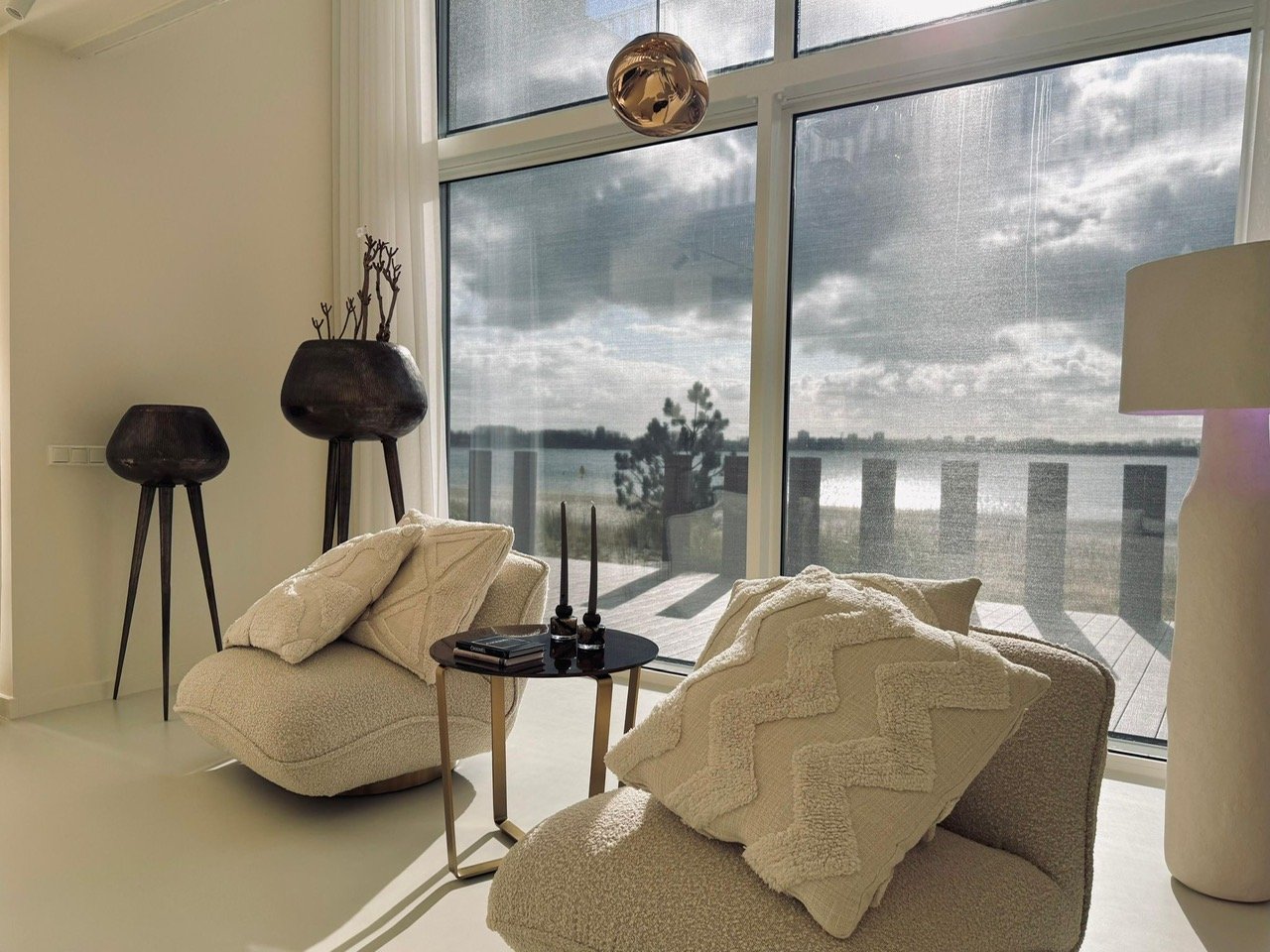
A seamless floor in the living room brings calm, spaciousness and warmth. Our choice: Lavasteen Seamless Floor (epoxy-based, robust for daily use) in a warm shade such as Sea Shell, Linnen or Pearl. Combine with wooden furniture for a natural look. Read more about the seamless floor in the living room.
For your bathroom
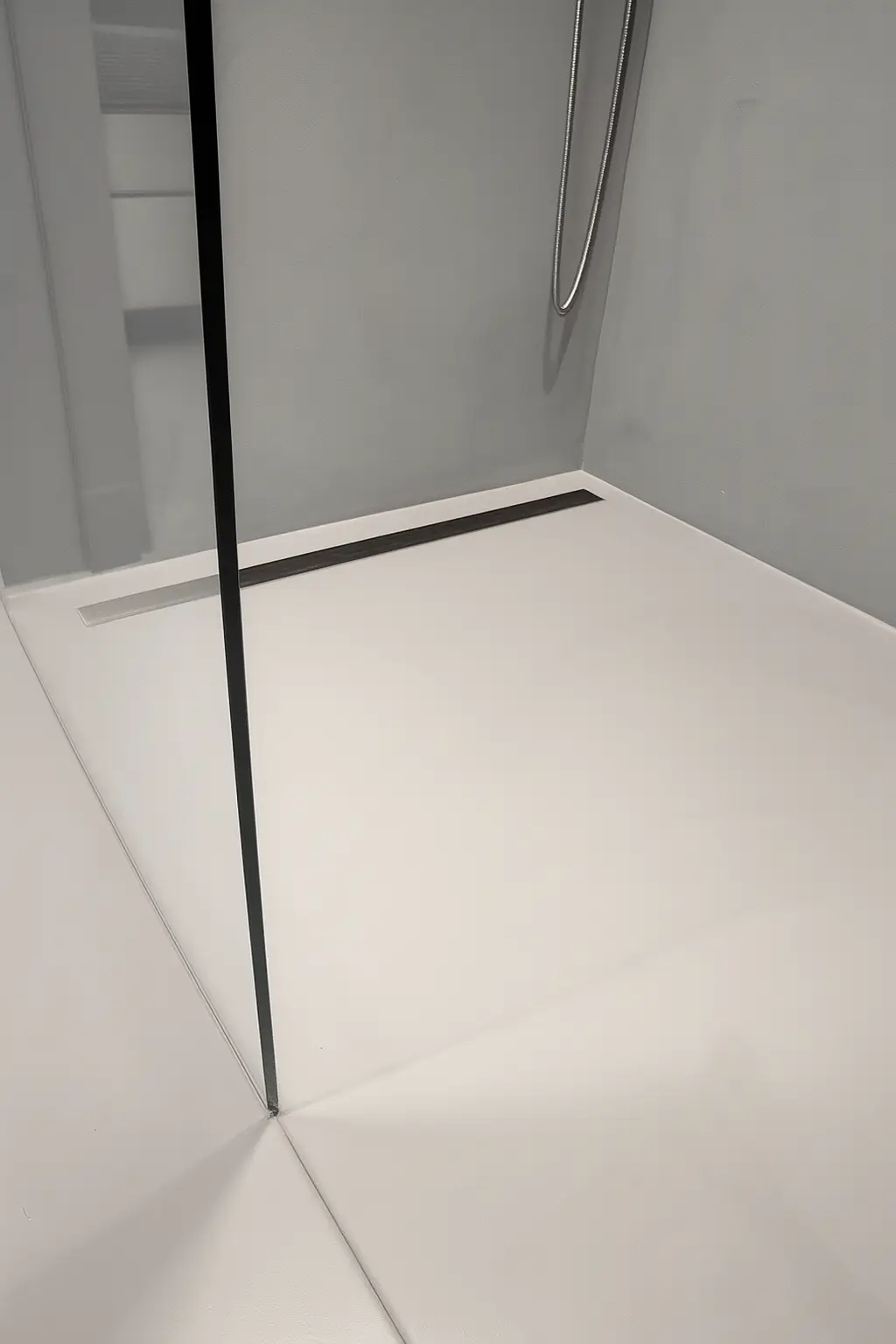
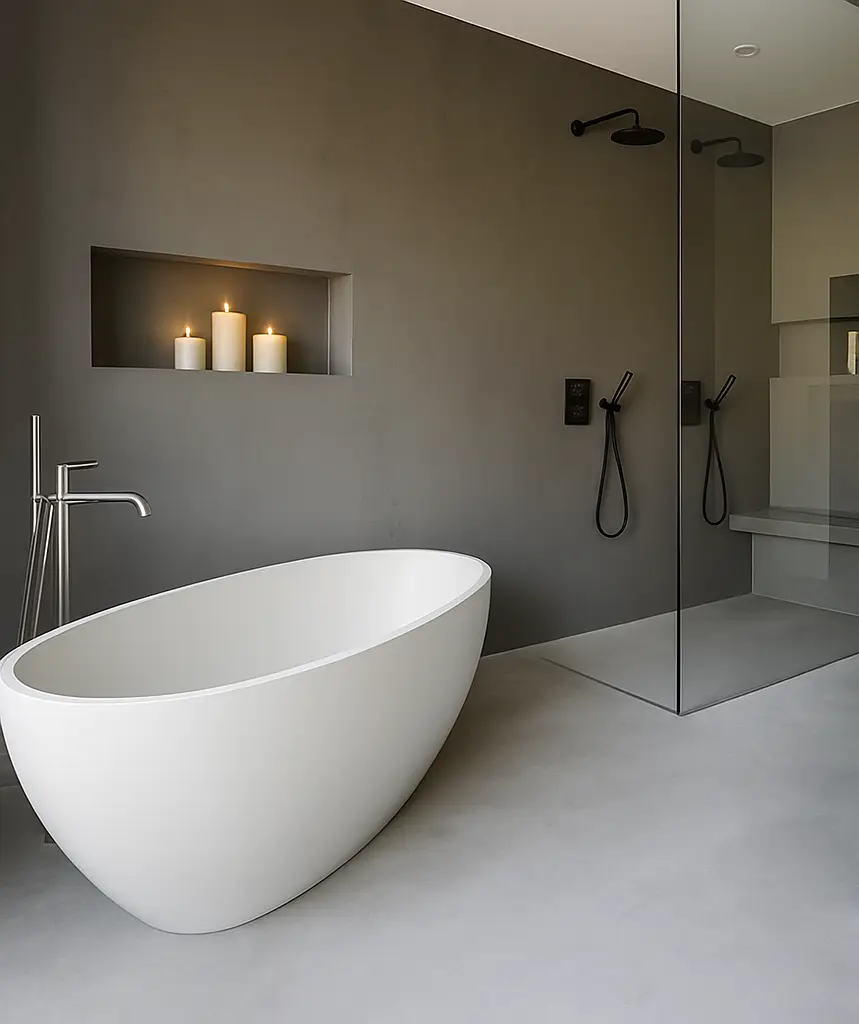
Here the difference between wall and floor matters. For the bathroom floor or shower floor: Lavasteen Seamless Floor (inherently waterproof, even when damaged). For the bathroom walls: microcement (matte mineral finish, broader colour palette).
For your kitchen
Lavasteen Seamless Floor is the strong choice. Seamless around the hob, with PU topcoat stain-resistant (coffee, oil, wine → mopping suffices). For accent walls or kitchen islands: microcement.
For your toilet
Small surface area, often worth a complete renovation. Lavasteen Seamless Floor on the floor + microcement on the wall = entirely seamless. Our 5 m² bucket is sufficient for most toilets.
For a staircase
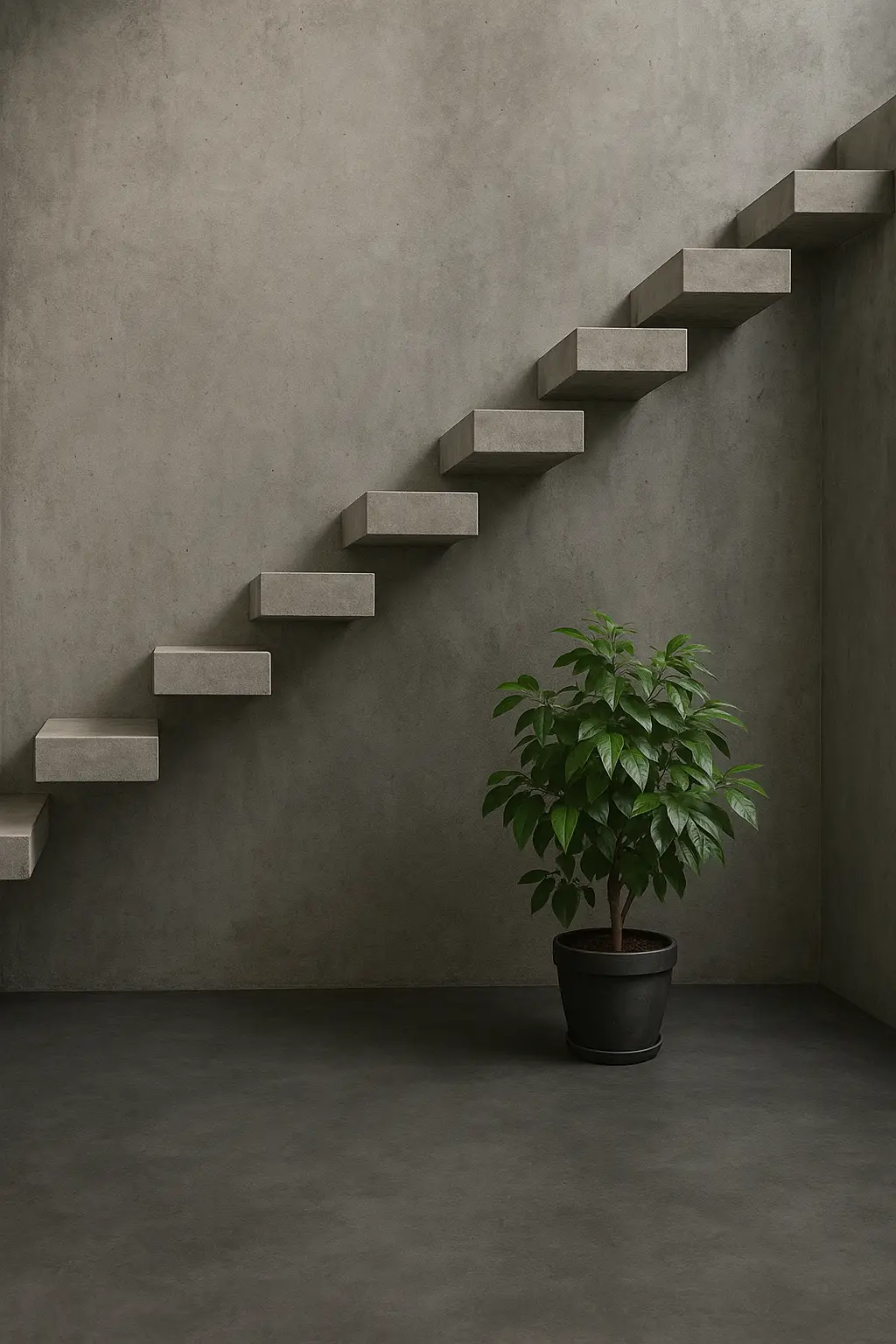
Microcement is perfect here — thin application on any geometry. Hard-wearing with 2 PU coats.
What does a seamless floor cost?
Do-it-yourself kits
Our kits are designed for DIY, with instructions and tool recommendations:
- Microcement: from £ 31 per m² (5 m² bucket at £ 155)
- Lavasteen Seamless Floor: from £ 47 per m² (5 m² bucket at £ 235)
Professional installation
- Microcement floor: £ 80–120 per m² including material and labour
- Lavasteen Seamless Floor: £ 90–150 per m² including material and labour
Price depends on: substrate (bare screed = cheaper than removing tiles), colour choice (NCS/RAL bespoke = surcharge), surface area (larger = lower m² price due to economies of scale).
Comparison with tiles: a tiled floor typically costs £ 60–120 per m² including installation. Seamless floors are in the same price range but you get: no grout lines, no demolition during renovation, faster installation (3–4 days), more contemporary appearance.
Pros and cons of seamless floors
Advantages
- Seamless & modern — no joints, no transitions.
- Durable — 15+ years lifespan under normal use.
- Low-maintenance — mopping suffices, no joints that sag.
- Hygienic — no dirt traps, allergy-friendly.
- Underfloor heating — thin = rapid heat conduction.
- Renovation-friendly — works over existing tiles.
- Bespoke — 56 standard colours plus NCS/RAL custom.
Disadvantages / points of attention
- Not self-repairable in case of major damage — requires specialist for localised renovation.
- Application requires precision — DIY possible, but for larger spaces we recommend a professional.
- Not all substrates are suitable — timber with movement, poorly cured anhydrite can cause problems.
- Shows dirt more quickly in white shades — just as with white tiles, but less than joints.
Frequently asked questions about seamless floors
How long does a seamless floor last?
With normal use: 15+ years. The mineral or epoxy layer itself lasts decades. The PU topcoat may wear after 8–12 years and can then be reapplied in 1 day's work — without replacing the entire floor.
Can a seamless floor be applied over existing tiles?
Yes. With a bonding primer, we apply our layers over tiles after proper preparation (cleaning, sanding, bonding primer). Saves demolition costs and waste disposal. However: tiles must be firmly fixed (no loose tiles, no cracks).
Does a poured floor work with underfloor heating?
Thanks to the thin build-up (1–3 mm), heat conducts quickly through — you feel it faster than with thick tiles. Important note: underfloor heating must be warmed up slowly before application to prevent cracking.
What is the difference between a poured floor and microcement?
Closely related but not identical — béton ciré is the French name from the same product family; microcement is harder and has a more subtle texture. Both are mineral cement-based finishes. At Smartdeco we use “microcement” as the international standard product term. Lavasteen Seamless Floor is a different product (epoxy-based), not the same as béton ciré.
Can I apply a seamless floor myself?
For smaller areas (up to 25 m²) or a wall: yes, with our kits and instructions that's possible. For larger areas and complex spaces (bathroom with drains) we often recommend a professional. View our microcement guide or Lavasteen guide.
How long does the application take?
For a bathroom (5–10 m²): 3–4 working days incl. drying time. For a living room (25–40 m²): 4–5 working days. Fully cured within 7 days.
Is a poured floor sound-dampening?
Limited — the thin build-up provides virtually no insulation. For additional sound insulation, we recommend a specialist underlay before our finish.
Ready to choose your seamless floor?
Request up to 3 colour samples to assess in your own lighting conditions, or submit your project directly to us for a bespoke quotation.